
Risk management is the foundation of a successful project: the ability to identify risks, assess them, and take action (=prioritizing the most serious ones) is an absolutely essential skill.
In this article, I explain how to transform your team’s fears into concrete risks, map them onto a probability/impact matrix, and prioritize your mitigation efforts. I also share two mistakes that you must absolutely avoid.
To begin with, let’s start with the obvious: you need to manage risks.
What does that mean? Simply put:
People can report risks to you.
Once a risk is identified, you have a management process in place.
In response to risks, you implement specific actions, prioritized by order of importance.
1/ Identify
If you do not actively manage risks, you end up in a well-known state within human psychology; one that can cause significant damage precisely because of the inaction it breeds: the zone of denial.
I will dedicate an entire article to this in 2027, but for now, take my word for it: if you want your project to succeed, you must face your risks head-on.
To borrow an example from a recent LinkedIn post: imagine you have booked a train ticket for an upcoming trip. Now, imagine that the social climate is complex and the railway company you booked with is frequently prone to strikes (any resemblance to actual events is purely coincidental).
The risk, therefore, is that your train might be cancelled due to strikes.
Once identified, this may feel a bit more unsettling at first, but it allows you to manage the situation consciously and far more effectively.
Another piece of advice I often give to project managers (both junior and more experienced) is to acknowledge the emotions felt by the team (as well as your own) and then translate them into concrete risks.
People will frequently share their fears with you. It’s easy to assume that "change management" is all that’s needed to address this - and, to a large extent, that’s true.
However, behind a stated fear (such as "I’m worried that no one will buy my new product") there may be an objective risk. In this case, the objective risk is a loss of revenue. And that is something you can work on.
The takeaway: don’t dismiss the emotions of your project team or your various stakeholders. Instead, ask yourself how you can turn those feelings into tangible risks, and then manage them accordingly.
2/ Evaluate
What does it mean to manage and handle risks once they have been identified?
Regardless of the specific risk, there are two initial questions you should ask yourself:
1/ What is the probability of the risk occurring?
Using the train example: this likely depends on the day of the week (for instance, demonstrations often take place on Tuesdays and Saturdays) and the specific route (as some lines are far more affected than others).
2/ What is the potential impact of this risk on your objectives?
Were you heading to an interview for your dream job, and that was the only train available? Or were you planning a one-off trip to the beach in 2027, meaning you’ll simply have to reschedule? Depending on the situation and the consequences the risk might trigger, you can categorize its impact—ranging from minimal (requiring a simple adjustment to your schedule) to maximal (altering the course of your life).
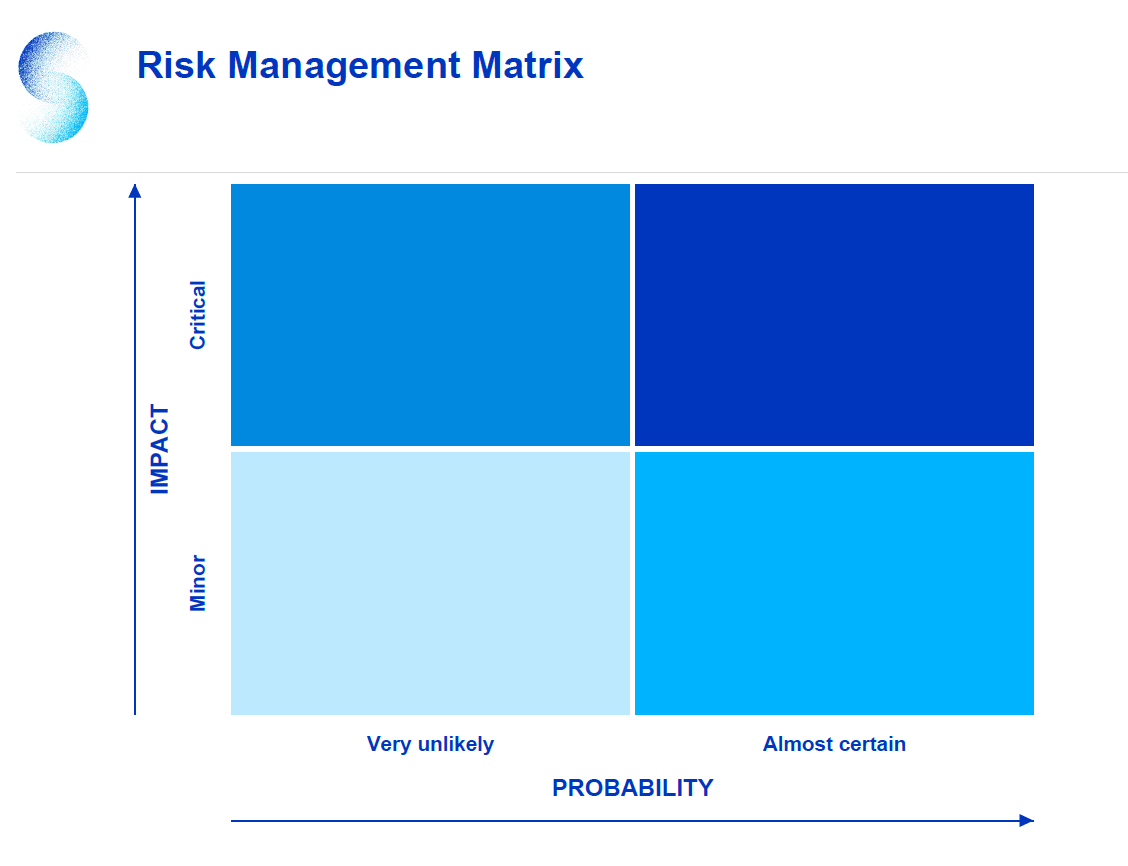
Once you have the answers to these two questions, I recommend plotting your risk on a matrix—like the one shown at the beginning of this article (this is one of the few times I will strongly recommend a specific tool, especially one designed for visual management).
These matrices come in varying levels of detail; the right choice depends on your own management style. Ultimately, what matters most is the content and effectiveness of the tool you use (I refer you here for more context!).
3/ Manage
Final step: stop being a passive observer and start taking action. The greater the potential impact of a risk—and the higher the likelihood of it occurring—the more robust the countermeasures you need to put in place. Could you consider alternative modes of transport? Should you change the day you travel? Could you reschedule the appointment that prompted you to book that train ticket in the first place?
Some actions may be feasible, others not; the goal is to shift your risk back into a zone where both its potential impact and its probability of occurrence are minimal.
And to avoid ending up with a list of action items as long as a tax return form, I have one piece of advice: prioritize.
Focus on risk mitigation actions only when the impact is major and the probability is high. Once those risks are “managed,” move on to those with a major impact but a lower probability. By that point, your project should be well under control.
Of course, I’m assuming that you have a regular process for reviewing these risks, along with the appropriate governance structures to support it 🙂
Let's end with the most common risk management mistakes
Mistake #1: Penalizing the messenger / the person who raises the risk.
As mentioned earlier, risks often surface through emotions. Furthermore, risks are inherently disruptive. From a short-term perspective - which is the approach our brains naturally favor - managing a risk requires more effort than simply ignoring it. Consequently, you might be tempted to push the risk back onto the person who brought it to your attention (sometimes, this may be justified!). But before doing so, conduct a quick assessment:
What is the risk being raised?
Where does it fall on the matrix?
Does the person raising the risk have the means to take action to reduce its impact or likelihood?
Mistake #2: Failing to escalate a risk to your management, for fear of being perceived negatively.
A project that is going well involves no risks; right?
Some people believe this is how things should be, and that raising a risk is a sign of failure. So, they say nothing, and at go-live, the project falls apart.
In reality, it is quite the opposite: a successful project is one where the risks associated with the transformation are identified from the outset, with action plans put in place at a very early stage.
Of course, this doesn’t mean you should escalate every tiny, improbable risk. However, the sooner you flag a risk, the better the chance the project team has to manage it. So, if something is genuinely worrying you, and there is nothing you can do about it yourself: speak up.
Let's sum-up
Manage your risks: bring them to light, decide how to handle them, and address them in order of importance. Ignoring them means drifting into a state of denial.
Translate the team’s emotions into tangible risks: behind a fear, there is often a concrete risk that can be managed.
Evaluate each risk by asking two questions (probability and impact), then plot it on a matrix.
Prioritize your actions: tackle risks with high impact and high probability first, followed by those with high impact but lower probability.
Avoid two common mistakes: penalizing the messenger, and failing to report a risk to your superiors for fear of being judged negatively.
There is no such thing as a risk-free project. A project that confronts its risks head-on has a real chance of success.
So, which risk will you manage more effectively this week? 🙂
You have doubts about the risks identified in your project ?
I can help you with the project audit: a quick diagnosis to identify what's missing and give you concrete recommendations.
👉 Discover the Project Audit offer
I hope this article gave you some clarity, and I'll see you soon to break down another one of the last 10 keys to running a strong project!